
19 May 2026 · Real People doing awesome stuff
Trust at 3500 watts: Hugh on piloting Steven Kemp
Fresh back from the European tandem World Cup circuit, Hugh talks piloting blind athlete Steven Kemp, the chaos of tandem racing, and what's next.
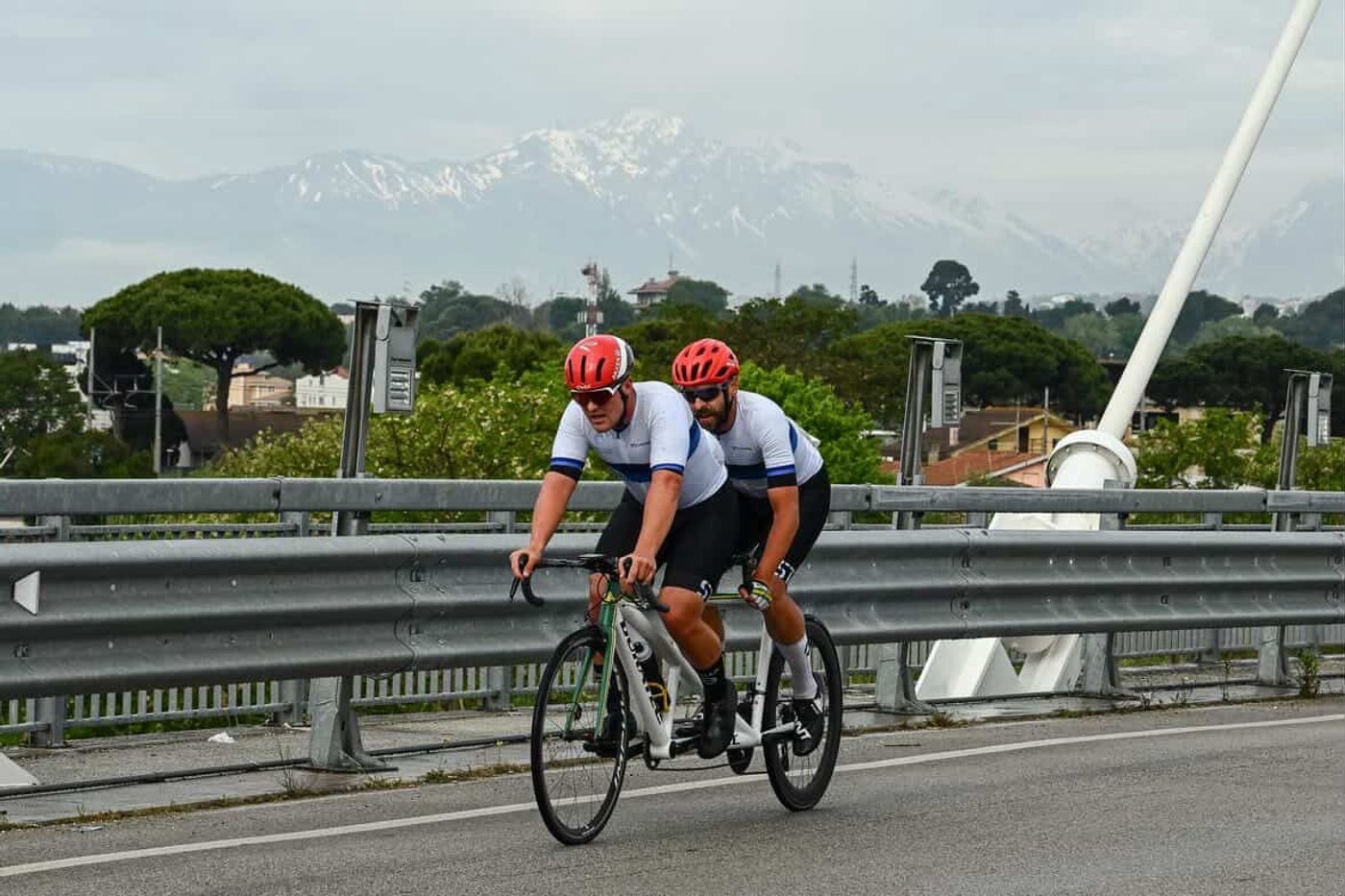
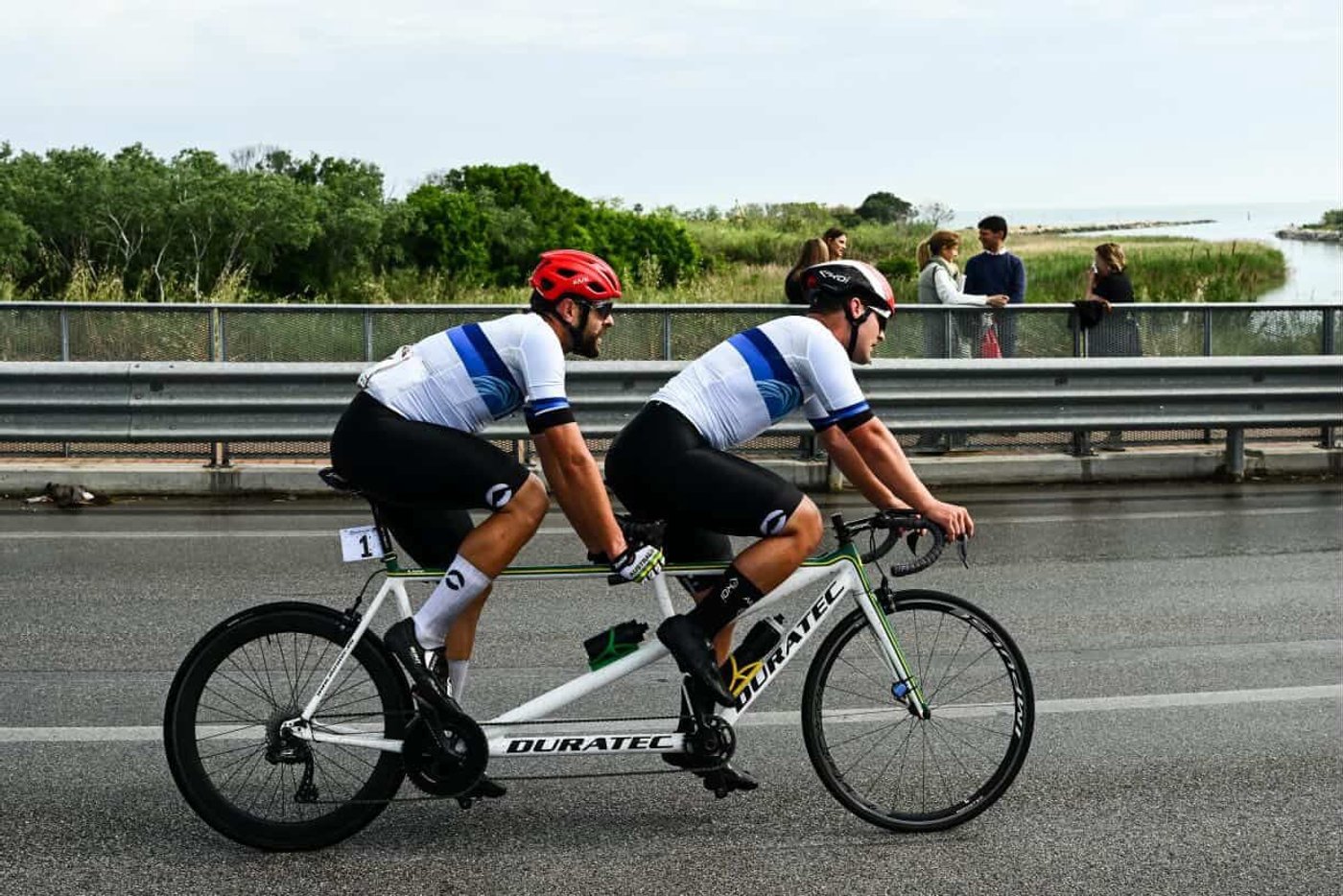
There's plenty to ask Hugh about next time you see him on an MC Velo ride or at the Clubhouse. He's just back from the European tandem World Cup circuit, where he piloted blind athlete Steven Kemp. We sat down with Hugh for a chat about the experience and a look inside the world of tandem racing.
Hugh, for people who don’t follow tandem racing, can you paint a picture of what a typical race looks like? Where were you racing, what's the format, and who's on the start line?
Tandem racing is chaos in the most exciting way. Most events are made up of a time trial and a road race, but the road races are the exciting ones! Usually they start with around 30 minutes of absolute carnage; pushing, shoving, crashes, and incredibly high speeds. The opening laps of a course are normally decisive. There’s usually one key corner, climb, or technical section early in the race where the field splits apart. If you’re positioned well, you make the front group. If not, the race explodes around you.
The fields might not be huge (usually 30 bikes), but the level is extremely high. In Europe we raced in Belgium and Italy against the best tandem pairings in the world, many of whom have been racing together for years as full-time paid professional para-athletes.
How did you end up in the pilot’s seat? Was it something you pursued, or did the opportunity come to you?
I first rode a tandem at the AusCycling National Championships in 2023. Shortly after that, I received my professional contract, which kept me racing in Europe for the next few years with Waterlsey R+D and Arkéa B&B Hôtels.
Following my retirement announcement, Steven reached out to me. Tandem pilots are a pretty unique breed. Across the elite division they’re typically big, powerful riders; usually over 90kg, over 6’2”, incredibly strong, and probably a little bit crazy. Other than the height requirement, Steven decided I matched the search category well enough.
What does piloting a tandem involve that’s different from racing a single bike?
Everything is bigger and faster on a tandem. The bike is heavier, longer, harder to stop, and far less forgiving. They handle like a bus on ice. They don’t really turn, and they definitely don’t stop in a hurry, but they are predictable once you understand them.
With so much weight and momentum, the bike can actually begin to slide underneath you in corners, but because of the wheelbase you often have enough time to catch it. In Italy we raced on brand-new roads in heavy rain with rim brakes, so both the braking systems and my piloting skills were put to the test.
At race pace, tandems become wild machines. The flex from the rear rider can steer the front of the bike, wheels flex under load, chains drop, chains snap, cassettes explode, and spokes snap. When Steven and I sprint together at around 3500 watts combined, the bike feels like a rope pulled taut, shaking and twisting, but it’s not a rope, it’s reinforced alloy.
How do you (as pilot) and Steven (as stoker) communicate during races?
Communication is everything in racing. Some stokers have great vision comparatively. Many of our blind competitors train on the road by themselves, do altitude camps and train in professional environments as if their vision impairment is purely a legal distinction. This of course reduces their communication with their pilot. However, for me and Steven, almost everything is called. We’ve developed a numbering system for effort and a specific vocabulary for accelerations, standing up, sprinting, braking, and technical sections.
One thing most riders would never think about is calling bumps in the road. As a pilot, you naturally brace yourself, you tighten your grip, lift slightly off the saddle, and prepare your body. The stoker doesn’t get that warning unless you tell them. Call the bumps.
Trust seems central to the whole experience. How do you build that trust?
The level of trust stokers place in pilots is still something I struggle to fully comprehend. Steven’s view is fairly simple: either he trusts the pilot and performs, or he doesn’t ride at all.
There’s a huge responsibility attached to piloting. You’re not just managing your own safety anymore. Steven is a husband and a father, and that absolutely weighs on my mind during training and racing. I’ve become far more cautious around dangerous situations and poor decisions particularly with cars. There’s no point being in right if you end up on the ground or worse.
Steven jokes that he trusts me because I’d also rather not crash. Thankfully, that seems to be enough.
Was there a moment where the partnership really clicked?
There were definitely moments where things suddenly started to flow naturally. Sprint timing, cornering, accelerations etc.
At the same time, tandem racing exposes mistakes immediately. If communication is late, positioning is poor, or timing is off, the consequences are amplified.
How did tandem racing compare tactically to your experience racing professionally with Arkéa–B&B Hôtels?
They’re completely different sports in many ways.
In professional road racing there’s a huge tactical and team element. In tandem racing, especially in smaller fields, races are often decided by positioning into one critical section or by who enters the final corner first for a sprint.
My experience with Arkéa helped with race instinct and tactical awareness, but honestly, a lot of our races are educated guesswork. With experience this will change. We were racing against pairings with years and years of experience together, while Steven and I had only raced a handful of events together beforehand.
Despite that, we managed solid mid-pack results against the best para-cyclists in the world, which we’re both proud of given the circumstances.
What’s next for your own riding, coaching, and tandem racing?
After retiring from professional racing, fitness disappeared pretty quickly and the weight came on faster than I’d like to admit. But one month of fully committing again brought my numbers surprisingly close to where they were as a professional.
Now that I’ve restarted that process, I want to hold onto the form and keep building.
For Steven and me, our big goal is racing the World Championships in the United States, depending on funding and support. Our World Cup results might not sound spectacular on paper, but considering we’re both balancing jobs (and Steven a family) and are still relatively inexperienced as a tandem pairing, we were very competitive against full-time professional para-athletes.
Those are the same riders we could line up against at World Championships. This prospect excites us, we hope this is the start of the story, not the end!